
Cardinal Richelieu has said: “The past bears no reference to the present; the relationship between times, places and persons is always an entirely different one.”
Richelieu, of Three Musketeers fame, France’s Cromwell, imagineer of the modern French state, whose name lives on in the village where once his castle stood and where I spent the waning and waxing days of 2025 and ’26.
I take the quote from book two of Carl Jacob Burckhardt’s three-volume biography of the Cardinal, Richelieu and His Age (1972). Books that are about a person and their age intend to showcase how times make people and people make times. Richard Holbrooke and the End of the American Century. The Years of Lyndon Johnson. Marquis de Lafayette in the Age of Revolution. As if, in Richelieu’s line, they have a relationship unlike any other. Richelieu’s age was the early 17th century. An age of centralized regimes, religious oppression, and the Académie Française, which he founded. He was a hard-working, intriguing, and sickly man. It was an age he shaped.
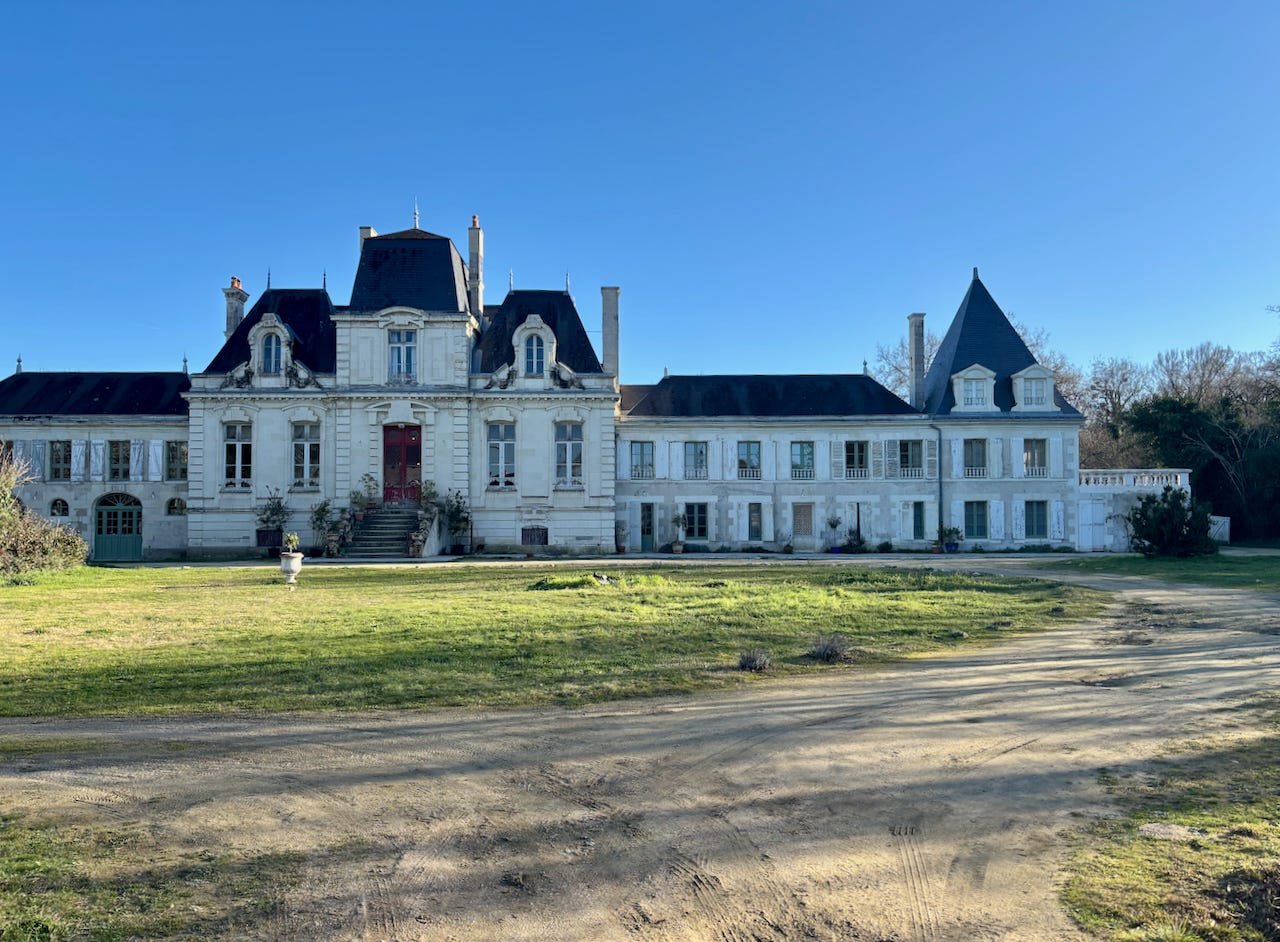
I found the biography on top of the piano in the music room of Académie Le Grippault, where we spent the winter holiday at the invitation of Jeroen and Leonoor. Richelieu, the village, was next door. The floor tiles from his now-lost castle decorated the central hall. I went running in the Cardinal’s park. Yet the time was decidedly not early 17th but rather late 19th century.
Jeroen and Leonoor, friends from the Netherlands, bought and renovated Le Grippault over the last few years. Dutch readers may know them from the RTL series that documented their adventure. We’d visited a few times for a day; this was the first time we actually stayed there, together with a few other families, to celebrate the New Year. It was a marvel.
The word château has different connotations based on your frame of reference. My initial thought is of a castle. Le Grippault, however, is a country house. More Downton Abbey than Knights of the Round Table. Jeroen and Leonoor have updated its ancient splendor and filled the place with art, music, and literature. As alive as heritage sites tend to be stale, places like this trigger my intellectual self-indulgence. Next to the coffee machine I found Rilke’s The Book of Hours (Das Stunden-Buch):
Ich lebe mein Leben in wachsenden Ringen, die sich über die Dinge ziehn.
Ich werde den letzten vielleicht nicht vollbringen, aber versuchen will ich ihn.Ich kreise um Gott, um den uralten Turm, und ich kreise jahrtausendelang;
und ich weiß noch nicht: bin ich ein Falke, ein Sturm oder ein großer Gesang.
— Rainer Maria Rilke
I sat down to pretend to understand German in the dining room, and the late 19th century came to life. With 22 people, half of them kids, breakfast in a high-ceilinged room with a fireplace felt like an Ibsen play. I’d always imagined such rooms, one door on the left, two doors on the right, and a door in the back leading to the kitchen and staff quarters, as a convenient theatrical setting. Turns out that if you eat oats in such décor even in the twenty-one-twenties, life becomes A Doll’s House. Kids clamor in through door stage left, recounting a game of Werewolf. Conversations really do drift in and out through doors, while I read Rilke as a prop.
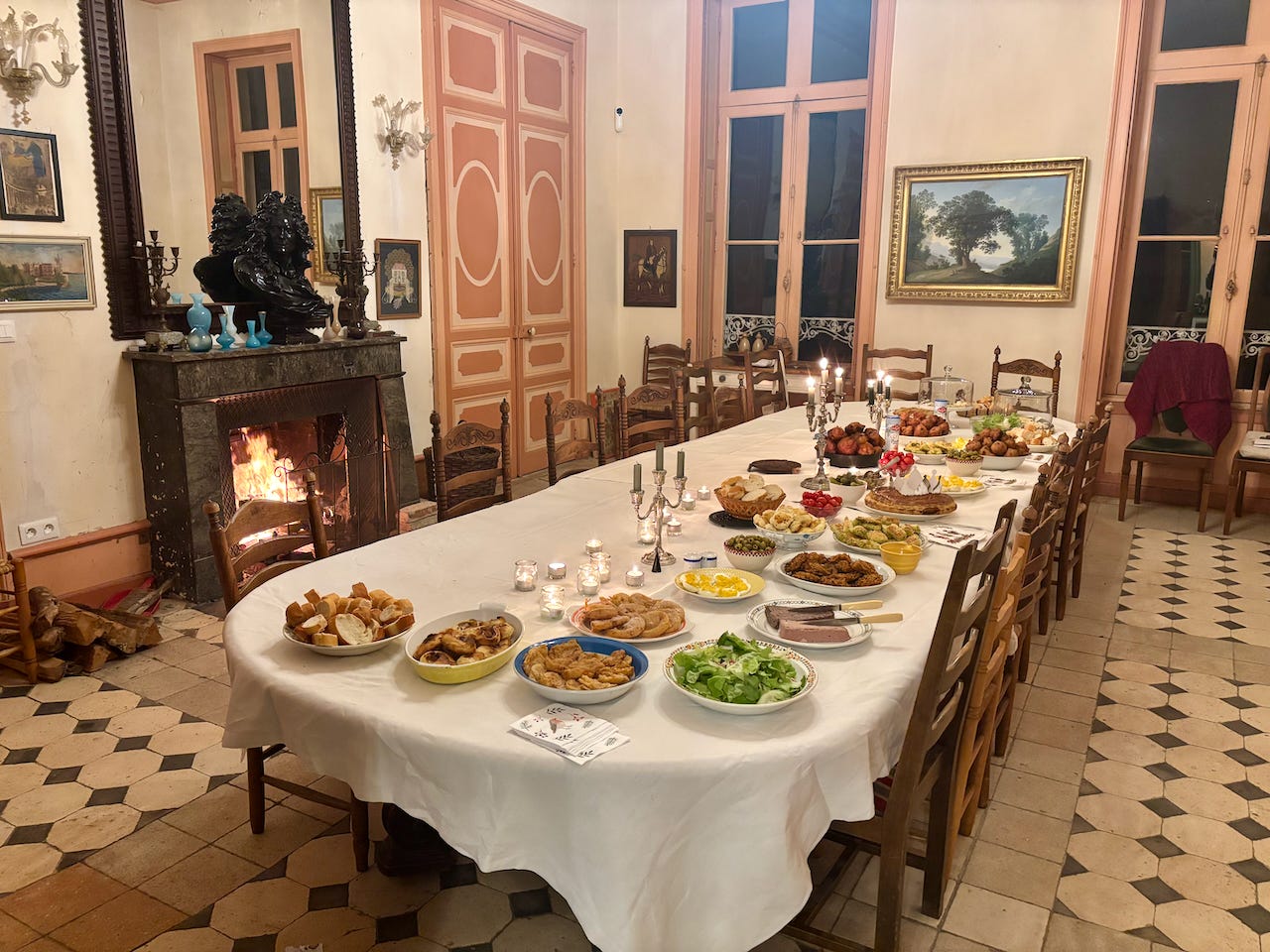
Nostalgic about a time I never lived in, the second thing that struck me about the late 19th century was how pleasant it was to prepare large dinners, read in the salon, or make a puzzle. It must have been wonderful to be an aristocrat. I spent most of my time on the estate, apart from the occasional hunt (to the Intermarché) and ride (run). I’m aware we now call this a vacation, but with a fireplace roaring and surrounded by antiques, I felt like a lord. Lesson two: just like the room with doors, the leisurely conversation of so many great plays isn’t a ploy, but based on lived experience.
“The past is not dead. It is not even past.”
— Te-Nehisi Coates
Among the books I brought myself was Te-Nehisi Coates’s The Message. The quote isn’t from the book; but the message is. Coates seemed as apt as Richelieu’s biography in an atmosphere of art, curiosity, and play. History is a widening circle that leaks, influences, echoes endlessly, and returns. So that even when I use AI to turn leftovers into party snacks at scale, I can still be in a modern drama in a Renaissance town.
In The Message, Coates writes,
“But then a writer told me a story and I saw something essential and terrible about the world. All our conversations of technique, of rhythm and metaphor, ultimately come down to this — to the stories we tell, to the need to haunt, which is to say to make people feel all that is now at stake.”
Hence, we are left with three choices: the past has no relevance to the present, it circles ever wider, or it haunts.
The 21st century added a swim in the icy pool on Jan. 1 to my stay. It added giving a helping hand to the work in and on the “downstairs” areas of the house. It added long days spent in the kitchen preparing food with the other guests, one of my favorite pastimes, which I would have hated to miss had I been an aristocrat. It also added centuries of understanding about how societies can be made fairer, and at least 150 years to the social critiques of Ibsen.
I look forward to the stories of the new year, drawing on history and art and all that is beautiful from the 17th, 19th, or 21st century. There is simply so much at stake. Thanks for your hospitality, Jeroen and Leonoor, and for reminding me it’s nice to write about the people that create places for reflection. Like I was not going to.
— Jasper
Happy New Year, Jasper. That was quite an entrée!